

AUDIO:
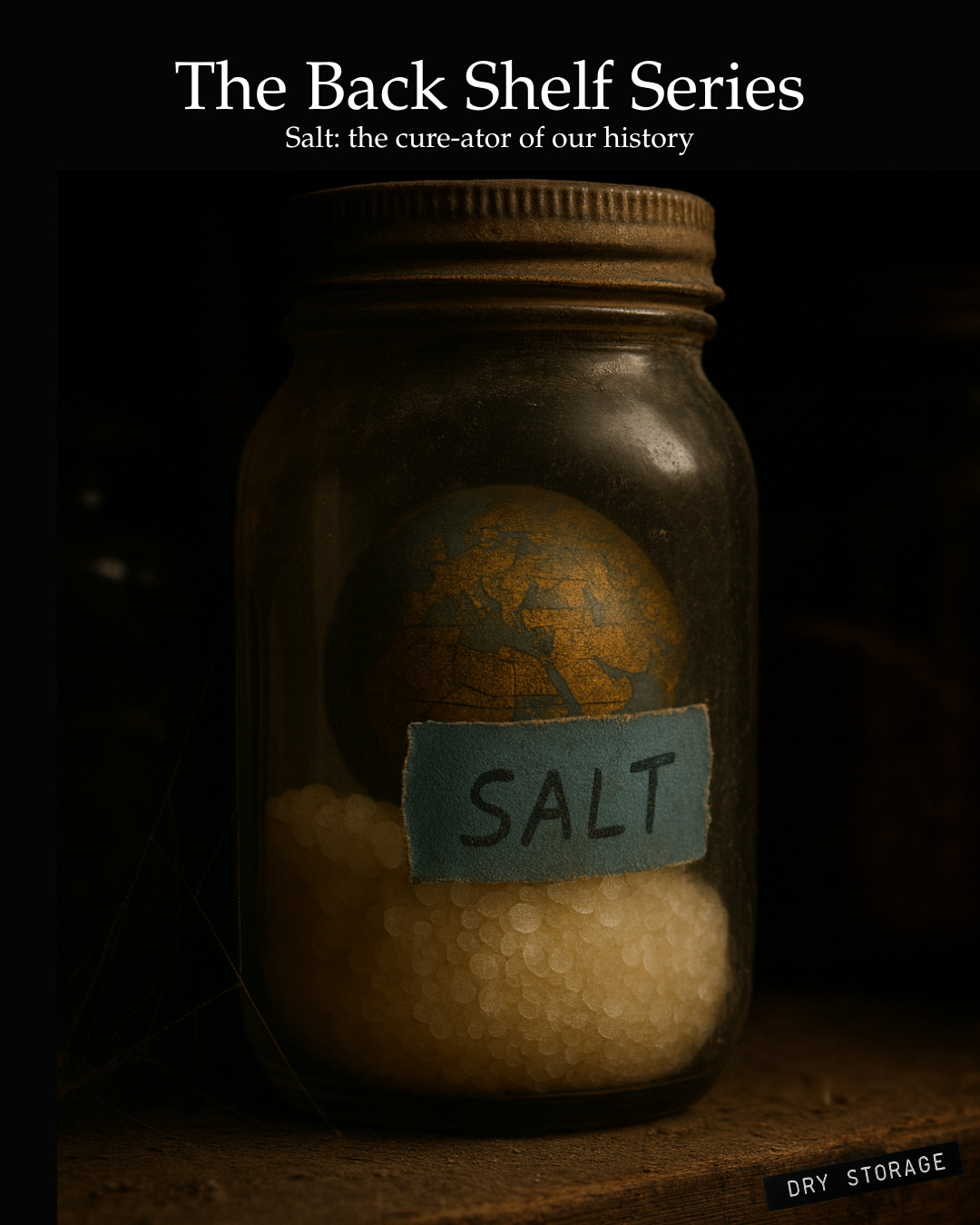
Once used as currency, later a monopoly. Kings taxed it; rebels marched for it. Priests sanctified with it; dietitians issued pamphlets demonizing it. From brine to bedrock — the maker or breaker of a dish.
Salt is often used in moderation, and often in the wrong way, by the general public — mostly due to a lack of awareness about how to use it best. For cooks (at least good ones), salt is sacred. For example, I've developed an almost unsettling relationship with one kind of salt that has become my best friend, my confidant, my rock (literally) in the kitchen. The kind of bond that has made me able to recognize it among a plethora of options if I were to be challenged to find it while blindfolded and just running it through my fingers. The holy Diamond Crystal Kosher Salt, it's just perfect... But I'll get into the whys in a bit.
You've probably heard someone say restaurant food just tastes better. Here's the little secret: it's the un-discriminated amount of butter... and the proper and intentional amount of salt. People fear salt, underestimating and overestimating its power in equal measure. It can either save a dish or seal its fate into the trash bin — a contradiction in its purest form.
So here's what I want to achieve by sharing this salt gospel with you: I want you to feel confident enough to use salt properly. Not through a technical how-to — there are a thousand Ramsay clips that can teach you why you should sprinkle it from a height, in order to evenly cover the food you're seasoning with it — I am not here to preach that. My goal is to provide you with enough info about this overlooked staple ingredient in order to understand the true grit of those grains running through your fingers every time you season your food.
Before we get to the politics and power plays, let's strip salt back to its pure form — where it comes from, how it's made, and why no two salts taste the same.
Salt X-Ray: The Raw Body of a Crystal
Before it became holy, before it sparked revolts, before chefs threw it from the elbow like confetti, salt was just a crystal (in simpler terms). Sodium chloride. Two atoms held together by an ionic bond, stacked into neat little cubes by the laws of physics. That's the simplest truth — but this simplicity hides the reason salt became indispensable. It dissolves easily in water. It attracts moisture. It preserves, it seasons, it transforms.
Formula: NaCl — one positively charged sodium ion, one negatively charged chloride ion.
Structure: Cubic crystal lattice, each grain a tiny geometric miracle.
Behavior: Hygroscopic (pulls water toward it). Dissolves into ions that carry electricity. Stable, cheap, abundant... but never optional.
This is the invisible skeleton of flavor and our own survival. Salt conducts nerve impulses, regulates hydration, and balances blood pressure. Without it, your muscles can't contract and your heart can't beat. With too much, your veins stiffen, your body bloats, and doctors scold you into flavorless purgatory.
In other words: salt keeps us alive — but walks on a tight rope between the latter and potentially killing us.
Salt in Our Body
Why do we crave it? Because we're walking oceans. Our bodies have been shaped and formed by water - we have an ocean inside us. Like the Earth, we are 70% saltwater. In 1897 French physician René Quinton discovered a 98% match between our blood plasma and sea water, or what we called 'ocean plasma'. Basically, life crawled out of saltwater and never forgot the taste, and it can't live without it.
The best way for me to know this statement is real, I just remember those times in which I had one too many drinks, even if those were made with mezcal and worm salt was present, and the next morning, the devil had carelessly woken me up with an insatiable nausea, dizziness and a hope to go into a coma. When I get a hangover I feel like I am E.T. on that scene in the movie where he's all pale and dying. But then the big G comes in a clutch move and quenches my thirst slowly giving me a will to roll out of bed and try to reclaim some dignity as a human being.
Electrolytes: Sodium is the courier of impulses between nerve and muscle. Every blink, every heartbeat, every sauté pan lifted is an electrical signal carried on sodium's labor.
Homeostasis: Too little salt → hyponatremia (confusion, seizures). Too much → hypertension, stroke risk. Balance is key.
Thirst & Craving: Animals will travel miles for a salt lick. Soldiers mutinied when rations lacked it. Cooks sneak pinches while tasting sauces. Salt is biology, obsession and a pure sign of personal perspective and opinion.
Salt in the Kitchen
Salt is the only seasoning that doesn't just add flavor — it changes the structure of food itself.
Osmosis: Sprinkle salt on eggplant, zucchini, or cucumber. Water beads on the surface as cells give up their liquid. Pat the foods dry and you're left with a drier surface that will be able to caramelize better, since maillard reaction is best achievable in the absence of moisture. Osmosis also conducts the artwork of brining a piece of meat in order to make it juicy and absorb tertiary flavors from spices and herbs. The process pushes in the seasoned liquid into the food and removes the inner water activity that is not as amusing as the one a cook creates to complement its natural flavors. Think of corned beef or a succulent thanksgiving turkey.
Protein Denaturation: Salt untangles proteins, making them bind differently. This is why a dry-brined steak browns more evenly and tastes beefier — the muscle fibers loosen, trap less water, and sear instead of steam.
The Salt Saturation Limit: But here's where salt reveals its most profound lesson about balance. Muscle fibers can only absorb limited amounts of salt before something remarkable happens — they start to reject it. Beyond this point, the "salting-out effect" kicks in, and the fibers actually shrink and push salt away. Even at the molecular level, food has evolved mechanisms to say "enough." There's wisdom in flesh that we've forgotten in our kitchens.
Enzyme Control: Salt slows some enzymes, accelerates others. In bread, it reins in yeast so dough doesn't blow up uncontrollably. In cheese, it halts bacteria at just the right moment.
Fermentation Gatekeeper: Sauerkraut, kimchi, miso — none exist without salt. Too little and rot takes over; too much and nothing ferments. Salt is both bouncer and host.
Strip away empires, taxes, memes, and myths, and salt is still this: a mineral that bends water, muscle, bacteria, and time to its will. Every human society had to bow to its physics before they could shape it into culture. But where does this power come from? To understand that, we need to step back and see salt at its most dramatic scale.
Salt in the World
Before humans learned to harvest it, salt was already writing stories across the planet. Not in books or on tablets, but in landscapes so vast and strange they feel like messages from another world. But these aren't just geological curiosities — they're active theaters where ancient techniques meet modern desperation, where global markets collide with local survival.
Bolivia: The Mirrors of Survival
Drive across Bolivia's Uyuni Salt Flats and you'll understand why the locals call it "the mirror of the sky." Twelve thousand square kilometers of pure salt, flat as a table, white as clouds. When the rains come, it becomes the world's largest mirror, reflecting the sky so perfectly you can't tell where earth ends and heaven begins.
But step closer and you'll see the human story written in salt pyramids. Here, 12,000 feet above sea level, families have been harvesting salt by hand for over 500 years using techniques that would challenge any modern engineer. The high-altitude brine evaporation process they've perfected requires reading weather patterns, understanding seasonal flooding cycles, and knowing exactly when the mineral concentration peaks for harvest.
The why is brutal and simple: at this altitude, nothing else grows. Salt harvesting isn't a romantic traditional craft — it's the only economy that works. Families organize into cooperatives, dividing the flats into hereditary plots passed down through generations. The work is backbreaking: raking salt into pyramids under UV radiation so intense it burns through clothing, for wages of $3-5 per day.
Yet this represents prosperity in highland Bolivia. These same salt flats that feed luxury finishing salt markets also sit atop massive lithium deposits — the raw material for electric car batteries. The families who've worked these flats for centuries now face a choice: preserve their traditional salt harvesting or lease their land to mining corporations promising wealth they've never imagined. Every salt pyramid you see is a family deciding between heritage and survival.
Chile: When Flamingos Set the Schedule
In Chile's Atacama Desert, the Salar de Atacama stretches like a frozen ocean of white and pink. The salt here is so pure, so concentrated, that it supports an ecosystem most would consider impossible: thousands of flamingos gathering to feast on algae that thrives in water with salinity levels reaching 28% — approaching the intensity of the Dead Sea.
The harvesters here have developed something extraordinary: a schedule that follows flamingo migration patterns. Traditional salt families coordinate their extraction cycles with conservationists, understanding that disturbing nesting areas means losing both the birds and the tourism that supplements their income. They've learned to read volcanic geology, distinguishing between different mineral deposits — knowing which areas yield table salt versus the lithium and potassium compounds that global battery manufacturers crave.
But this delicate balance is collapsing. Chile's Atacama contains 60% of the world's lithium reserves, making it ground zero for the electric vehicle revolution. Corporate mining operations are transforming traditional salt landscapes into industrial extraction sites. The same brine pools that sustained flamingo populations for millennia are now being pumped dry to feed Tesla factories.
The traditional salt families face an impossible equation: their sustainable harvesting methods, perfected over generations, cannot compete with industrial extraction. Some have become contractors for mining corporations. Others fight legal battles over water rights in the world's driest desert. All live with the knowledge that their craft is being sacrificed to power the world's transition to clean energy.
Pakistan: The Underground Inheritance
Descend into Pakistan's Khewra Salt Mine and you'll find an underground cathedral carved entirely from pink salt — walls, ceiling, even sculptures created by miners over centuries. This isn't just extraction; it's inhabitation. Miners have learned to live and work in salt chambers, developing techniques for carving spaces that provide both structural support and architectural beauty.
The "room-and-pillar" method they use leaves massive salt columns to support the tunnels while extracting everything else. Families spend entire shifts underground, breathing air so pure it's said to cure respiratory ailments, though the long-term effects of constant salt exposure remain largely unstudied. The work requires specialized knowledge: understanding how salt responds to temperature changes, how to carve without triggering collapses, how to read the mineral formations that indicate the highest-quality deposits.
The economic reality is harsh: while Himalayan pink salt sells for premium prices in Western health food stores, the miners extracting it earn wages barely above Pakistan's poverty line. The colonial-era British mining infrastructure still governs extraction rights, with local families working land they can never own. Many miners develop lung problems from decades of salt dust exposure, but the work provides steady employment in a region with few alternatives.
The contradiction is profound: the same salt that's marketed as "pure" and "natural" in luxury markets is extracted through industrial mining that's anything but. Every Instagram post featuring expensive pink salt represents dozens of underground shifts by workers whose names will never appear on the packaging.
The Dead Sea: Nature's Chemistry Experiment
With a whopping 34% salinity, ten times saltier than the ocean, so dense that human bodies float like corks. Here, salt concentration reaches levels that would kill most life forms, yet the water supports unique bacteria and creates therapeutic mud coveted by spas worldwide. The Dead Sea represents salt at its most extreme: a natural laboratory where mineral concentration becomes medicine, where geology becomes pharmacy.
The scientific specs are staggering: 280 grams of salt per liter of water, containing not just sodium chloride but magnesium, calcium, and potassium in concentrations found nowhere else on earth. It's salt as pure chemistry — a place where the compound reveals its full mineral complexity beyond simple seasoning.
But even here, human intervention threatens the natural balance. Water diversions have dropped the sea level by over 30 meters in recent decades, concentrating the brine further while exposing vast salt flats that once lay underwater. The Dead Sea is literally dying, becoming more of what it already was — a monument to salt in its most concentrated, most unforgiving form.
How Salt Reaches Your Shelf: The Universal Mathematics of Extraction
What unites these landscapes isn't just their geological beauty — it's the brutal mathematics of resource extraction in a global economy. Each location reveals the same pattern: traditional knowledge developed over centuries, now serving international markets that offer subsistence wages for luxury products.
The Bolivians' high-altitude expertise becomes content for travel influencers. The Chileans' ecological balance becomes raw material for clean energy. The Pakistanis' underground craftsmanship becomes premium health food marketing. In each case, local communities bear the environmental and health costs while global consumers enjoy the benefits.
These places remind us that salt's story began long before the first human ever tasted it, but they also force us to confront how that story continues today. Geological forces that dwarf our empires created these monuments to salt, but human economic forces are rapidly transforming them into something unrecognizable — and completely opposite to salt's fundamental purpose. After studying this compound, I've come to understand that salt exists to provide balance to our blue planet: regulating ocean chemistry, stabilizing ecosystems, maintaining the delicate equilibrium that allows life to flourish. Yet we've turned it against the balance of our social systems, using it to create inequality, exploitation, and environmental destruction. The mineral that exists to balance our world becomes a tool for imbalancing our societies.
Next time you find yourself standing at the edge of one of these salt monuments or see a trendy post of these tourist hotspots on your feed, realize that every grain in your kitchen carries more than the memory of deep time — it carries the sweat of families working impossible landscapes, the environmental cost of global supply chains, and the complicated legacy of traditional knowledge being monetized by markets that will never value the hands that harvest it.
The Three Paths from Monument to Shelf
Understanding how salt transforms from these geological monuments into the crystals in your kitchen requires knowing the three primary extraction methods that have evolved over millennia.
Solar Evaporation: The oldest method, still used today in places like France's Guérande and Portugal's Aveiro. Seawater is channeled into shallow ponds where sun and wind do the work. As water evaporates, salt concentration increases until crystals form. The process takes months and requires perfect weather conditions, but produces some of the world's finest salts with complex mineral profiles.
Rock Mining: Ancient sea beds, now buried underground, are accessed through traditional mining. The Wieliczka Salt Mine in Poland, the Khewra Mine in Pakistan — these operations extract solid halite deposits left by prehistoric oceans. Miners use room-and-pillar techniques, leaving salt columns to support the tunnels while harvesting everything else.
Solution Mining: The modern industrial method: pump water into underground salt deposits, dissolve the salt, then pump the brine back to the surface for processing. It's efficient and produces pure sodium chloride, but strips away the trace minerals that give traditional salts their character.
Each method produces different results — from the complex flavors of hand-harvested sea salt to the reliable purity of solution-mined table salt. Understanding these processes helps explain why not all salts are created equal.
But regardless of the method, regardless of the landscape, all salt eventually takes the same journey: from these remote, often brutal places to the familiar forms we know. And once it arrives on your shelf, it reveals itself in an array of characters, each with its own personality and purpose.
The Compendium of Salts: A Pantry Tour
Now that we've followed salt from its molecular origins through our bodies, our kitchens, and across the world's most extreme landscapes, let's meet the characters that actually show up in your pantry. Because not all salts are equal. Some crunch like shattered glass, some melt instantly, some hide in pink veins of the earth, and some carry the smoke of maguey worms and volcanic coals.
This is salt as it shows up in the real world.
Table Salt
The supermarket default. Fine-grained, mined or evaporated, usually mixed with anti-caking agents and iodine. Dissolves quickly, seasons evenly, but can taste metallic if over-refined. The workhorse. Its very blandness makes it reliable for baking, where consistency trumps romance.
Where it shines: Bread dough, pasta water, anywhere measurement precision matters.
Kosher Salt
Large, flat flakes, originally used for drawing blood from meat in koshering rituals. Grains dissolve slower than table salt, so you feel more control. Pinching, sprinkling, seasoning — it flows like an extension of the hand. The chef's salt. Its tactile nature makes it the standard in most professional kitchens.
Where it shines: Steaks, brines, everyday seasoning by touch rather than scale. My beloved kind.
Sea Salt
Crystallized from evaporated seawater, often with trace minerals intact. Comes fine, flaky, or chunky. Brings minerality and subtle complexity beyond NaCl. The flavor can whisper of the coast where it was born. A bridge between function and romance — still salt, but with terroir.
Where it shines: Finishing grilled vegetables, chocolate desserts, anything needing a final glitter of brine.
Fleur de Sel
The delicate "flower" of salt, skimmed from the top of French salt pans. Paper-thin crystals, harvested by hand. Dissolves slowly on the tongue, giving bursts of salinity. Luxury born from fragility. Too precious to cook with, perfect to finish with.
Where it shines: Seared foie gras, caramels, a still-warm tomato slice.
Rock Salt
Coarse chunks of halite, mined from deposits left by ancient seas. Doesn't dissolve easily; used more for thermal control than flavor. The engineer's salt. You don't eat it; you harness it.
Where it shines: Ice cream churns, crusting whole fish, baking potatoes under a salt dome.
Himalayan Pink Salt
Mineral-rich halite from Pakistan's Khewra mine, colored pink by iron oxides. Milder than table salt, sometimes used in slabs for grilling or curing. Half seasoning, half décor. Marketed for "wellness," though scientifically it's still NaCl with trace minerals.
Where it shines: Curing meats, plating sushi on slabs, Instagram and yoga studios.
Pickling Salt
Pure granulated NaCl, no iodine or anti-caking agents. Dissolves cleanly in brines without clouding. Clarity matters. Anti-caking agents can make pickling liquid murky and interfere with fermentation.
Where it shines: Cucumbers, sauerkraut, miso. Preservation in its purest sense.
Sal Parrillera (Grilling Salt)
Coarse, pebble-like crystals common in South America. Melts slowly, seasoning meat as it sears over fire. Built for the parrilla. Its size makes it cling to meat and resist burning off.
Where it shines: Thick-cut steaks, asado, churrasco.
Sal de Gusano (Worm Salt)
Oaxacan salt blended with toasted, ground agave worms and chilies. Smoky, earthy, spicy. More condiment than pure seasoning. Salt as culture, ritual, and terroir — eaten with orange slices and mezcal.
Where it shines: Mezcal rituals, dusted on fruit, rimmed on cocktails.
Smoked Salt
Salt cold-smoked over woods like hickory, apple, or alder. Infuses smokiness without heat. Adds campfire depth without the fire.
Where it shines: Roasted vegetables, cocktails, vegan cooking where smokiness stands in for meat.
Black Salt (Kala Namak)
South Asian salt with sulfurous compounds, dark pink to black in color. Pungent, eggy aroma. A culinary trickster. Transforms the flavor profile with sulfur notes.
Where it shines: Chaats, chutneys, vegan "egg" salads.
Prague Powder/Curing Salt (Sodium Nitrite/Nitrate):
Pink-tinted salt with sodium nitrite (#1) or nitrate (#2), used for curing meats. The pink color prevents accidental consumption as table salt. Prevents botulism by inhibiting bacterial growth while preserving that distinctive "cured" flavor and pink color in bacon, ham, and salami.
Where it shines: Charcuterie, bacon, pastrami, any meat that needs to be preserved and stay pink rather than gray.
The controversy: Modern panic over "nitrates/nitrites" vs. the reality that celery powder (used in "uncured" meats) contains the same compounds naturally.
Flavored & Specialty Salts
Truffle Salt: Umami bomb for fries and popcorn.
Celery Salt: Key to Chicago dogs and Bloody Marys.
Herbed Salts: Shortcuts that carry the memory of summer gardens.
Why the Compendium Matters
Knowing which salt to reach for is like knowing which knife to pick up. Each has its edge, its strength, its purpose. A dough needs the accuracy of table or kosher salt. A thick bone-in short rib demands the coarse cling of parrillera for a long cooking process. A mezcal ritual calls for worm salt, earthy and alive.
Salt is never just "salt," not even in the kitchen. It's technique, culture, a tool and intention crystallized.
Now that you understand salt at every scale — from the ions in your blood to the landscapes that birth it to the crystals on your shelf — we can finally explore the real story: how this simple compound became the invisible thread running through every chapter of human history.
Salt Through the Ages: The Invisible Trail
In the Beginning, There Was Salt
Long before empires, before writing, before the wheel — in the beginning — humans were already organizing their lives around salt. Archaeological evidence from Solnitsata, Bulgaria reveals the world's first known salt works: a sophisticated Stone Age operation where communities boiled brine in ceramic vessels around 6,000 BCE, producing salt cakes that would travel across prehistoric Europe.
In ancient China, similar salt springs became the foundation of entire settlements. The Yangtze River valley holds evidence of massive salt production sites where our ancestors didn't just stumble upon salt — they engineered it. Wooden wells, ceramic boiling vessels, specialized tools for brine extraction. These weren't casual operations; they were industrial-scale prehistoric enterprises that required planning, cooperation, and technological innovation.
Salt was so valuable that Stone Age humans built permanent communities around it, developed specialized extraction techniques, and created trade networks spanning continents. Before there were roads, there were salt routes. Before there were currencies, salt was wealth itself.
This wasn't just about preserving meat for winter. Salt preserved something more fundamental: it preserved our first steps toward civilization itself. The same mineral that would later be witness and the cause of the following historical events.
Biblical & Ancient Near East
Before nation-states, before armies wore uniforms, salt was already currency. In the Bible, it appears again and again — the "covenant of salt" meant permanence, trust. Lot's wife, frozen mid-flight as a pillar of salt, is a warning that turning back can fossilize you. But there's more to her story than meets the eye.
See, Lot's wife Adit wasn't just some random victim of divine wrath. She was a native Sodomite who despised her husband's hospitality — especially when he asked her for salt to serve his mysterious guests. "Also this evil custom you wish to introduce into this place?" she snapped, then went door-to-door asking neighbors for salt, essentially alerting the whole city that Lot was harboring strangers. In Sodom, inhospitality wasn't just custom; it was law.
The Midrash (commentary on ancient Hebrew scriptures) puts it perfectly: "She sinned with salt, and she was punished with salt." She used salt as a weapon against hospitality, turning it into a tool of betrayal rather than welcome. When she looked back at the burning city despite the angels' warning, she became the very thing she had weaponized — crystallized cruelty, preserved forever as a monument to what happens when you turn sustenance into surveillance.
Salt preserved not just food but meaning: it stood for faith, loyalty, even wrath. But it also stood for choice — how you use it reveals who you are.
Meanwhile, across the ancient world, Egyptians were perfecting their own relationship with salt's cousin — natron. This sodium carbonate mixture was their secret weapon for mummification, desiccating bodies the same way we cure meat today. The ancient Egyptians essentially ran the world's first charcuterie operation, though their dry-aging process took 70 days and their customers never complained about the results. Cleopatra got the ultimate dry-aging treatment, preserved for millennia by the same mineral chemistry that keeps your prosciutto from spoiling.
The very first experience, deemed as spiritual, I had with salt outside a kitchen was during Shabbat dinners when my kabbalistic uncle tossed pieces of challah bread across the table right after dipping the pulled apart piece on a salt mound. The reason was because our table was compared to an altar, and since sacrifices brought on the altar all had salt, so too your bread should. Based on Kabbalah, it is done because bread represents divine kindness, whereas salt represents strict divine judgment. And, we want kindness to overpower strict judgment.
And then, another divine interaction with salt that I'll never forget was at the Dead Sea, what a bizarre place — where the water is too saline for life to swim but buoyant enough to float a body. My experience at the Dead Sea was, to say the least, humbling. It was hands down one of the worst FAFO moments in my life when I decided not to pay attention to the billboards on the shores of the Dead Sea in Israel that cautioned swimmers not to dip their heads in the water as if they were enjoying a bathing session in the Caribbean Sea, but 12-year-old me ignored the crawling trails of salt leading up to the road and along with that ignorance I missed the cue that salt called the shots in this place. As soon as I got into the weirdly pressuring waters of the Dead Sea in which the temperature was oddly warm and the saturation of it was felt on every inch of my skin, I did it, I fucked up and dipped my head to "refresh myself" — big no no. After recovering from the worst stinging sensation I've felt in my eyes before, I guess my refractory system succumbed to my pain and I took a piss, and boy I now was in trouble. I had experienced the true wrath of God's punishment and the reason behind the creation of such an insane place. He knew stupid people like me would try to play it cool and would need some humility brought down on them, the hard and stinging way. But anyways, besides a bodily painful experience I had with salt in its purest form, it does take a huge role in our body and it provides great assets for its functioning abilities, of course in moderation. Long story short, do pay attention to those signs, and don't be cocky or your cock will pay the price...
Salt in the Roman Empire
The famous quote "all roads lead to Rome" is often referred to the importance of the current Via Appia, and before its construction there was the Via Salaria — the Salt Road. It was one of Rome's first arteries, built not for armies or senators but for a mineral. Salt moved along this road from the mouth of the Tiber and the Adriatic coast into the heart of the city, feeding a growing empire one pinch at a time.
Salt didn't just season Roman food — it seasoned their language, their economy, and their imagination. The word salarium, the allowance soldiers received to buy salt, is the ancestor of our modern "salary." To this day, we still say a man "isn't worth his salt" if he doesn't pull his weight.
But the real Roman obsession was garum, their version of ketchup — a pungent, fermented fish sauce that clung to nearly every dish. Salt was its backbone. Whole coastal towns in Hispania, Portugal, and North Africa lived and died by salting fish guts into garum. Amphorae of the stuff moved across the empire like oil barrels today, pipelines of flavor and profit. A luxury grade, garum sociorum, was worth more than perfume. And even today, René Redzepi and his team sell a form of this concoction for $25 made with mushrooms in a cute labeled bottle for the globe's gourmands.
Salt could also be a weapon. After the Third Punic War in 146 BCE, legend says the Roman general Scipio Aemilianus plowed salt into the fields of Carthage so nothing would grow again. Historians now debate whether it actually happened, but the story stuck because it fit the Roman imagination: salt not just as life, but as total annihilation.
Rome also understood the quiet power of salt monopolies. The vectigal salis — salt tax — filled imperial coffers, and control of salt production meant control of preservation, of supply, of the very stability of society. A pinch of salt could preserve meat for months, but in Rome's hands, it preserved empires.
Salt even reached into the sacred. The Vestal Virgins prepared mola salsa, salted flour cakes, for sacrifices. A meal without salt was barbaric; to share salt was to declare loyalty. Salt wasn't just a condiment — it was a covenant, a pact.
Pliny the Elder, the encyclopedist and naval commander who died in the eruption of Vesuvius, wrote in his Natural History: "Civilized life cannot be lived without salt. It is so necessary that the word 'salary' derives from it." For Pliny, salt was as divine as fire or water — one of the basic elements of survival, proof that the simplest things often hold the deepest power.
Salt in the Medieval Age
Salt did not vanish with the fall of the Roman Empire. If anything, its importance hardened. When an empire collapses, roads crumble, aqueducts crack, and cities burn — but the need for food doesn't go away, it actually increases. Salt, the silent preserver, remained the constant. And in the medieval world, it wasn't just a commodity. It was lifeblood, a tax base, a covenant, and sometimes, the spark of revolution.
Salt Roads & Trade Networks
The Romans left behind their salt roads, and medieval Europe built its own. Venice, long before it was a city of glass and gondolas, was a city of salt — trading Adriatic brine for timber and grain. Genoa, Lübeck, and other rising powers of the Hanseatic League weren't built on spices from the East; they were built on barrels of herring and the salt to preserve them.
Further south, Africa was running its own salt empire. Caravans from the Sahara hauled massive slabs of rock salt across brutal deserts. Imagine camels loaded not with silk or incense, but with glittering white blocks, traded pound for pound with West African gold. In Timbuktu, the measure of wealth wasn't a coin but how many slabs of salt a man owned. Salt didn't just season the soup — it set the terms of global trade.
The Islamic Golden Age: Salt in Science & Spirit
In the Islamic Golden Age, salt was more than commerce. Scholars like Al-Razi and Ibn Sina (Avicenna) wrote of its cleansing power in medicine. Salt purified wounds, balanced humors, and, in Avicenna's words, "restored harmony to the body." Apothecaries stocked it next to herbs and oils, proof that salt sat comfortably at the crossroads of science and faith.
It also seeped into ritual life. Sprinkled to ward off evil, scattered for purification, dissolved into the rhythm of Islamic households. To live in the medieval Muslim world was to understand salt as both everyday seasoning and unseen protection.
And yet, even here, salt was politics. Caliphs and sultans taxed saltworks across North Africa and the Levant. Control of salt wasn't glamorous like conquest, but it was definitely a sign of power.
Salzburg: The Salt Castle
Meanwhile, in the heart of Europe, the Austrian city of Salzburg had turned salt taxation into high art. Literally named "Salt Castle," the city controlled the precious white roads between Alpine mines and Germanic markets. The archbishops who ruled there didn't just tax salt — they monopolized it, channeling every grain through their customs houses along the Salzach River.
For centuries, this salt wealth funded the court culture that employed musicians like Leopold Mozart and his prodigious son Wolfgang. Every crystalline note of Wolfgang's early compositions was made possible by an economic system built on salt taxes. The most beautiful classical music in human history, emerging from a patronage system underwritten by seasoning tariffs.
Christian Europe & the Salt Tax (The Gabelle)
By the 13th century, France had invented one of history's most despised taxes: the gabelle. What started as King Louis IX's simple salt tax to fund his Mediterranean ambitions evolved into bureaucratic sadism. Under Louis XIV, it reached its most grotesque form. France was divided into salt regions with wildly different rates — salt that sold for 2-3 livres per minot in Brittany could cost over 50 livres in the grandes gabelles regions around Paris. The crown had turned geography into lottery, and most people lost.
But here's where it gets really twisted: the sel du devoir. Every household was forced to buy a minimum amount of salt per year, whether they needed it or not. Seven pounds per person over the age of eight — not a suggestion, a legal requirement. The state had literally made salt mandatory, turning survival into subscription service.
Enter the faux-sauniers — salt smugglers who became folk heroes by accident. These weren't romantic rebels; they were desperate families buying cheap salt in Brittany and walking through forests at night to sell it in Paris. The penalties were medieval: smuggling salt meant the galleys or hanging. A pregnant woman caught with 20 pounds of untaxed salt got branded and three years in prison; her husband got the galleys for life.
Bread, cheese, fish — all depended on salt. To tax it was to tax survival itself. By 1789, salt hatred had crystallized into revolution. Some historians argue the fury that toppled the French monarchy owed as much to salt as it did to bread — both pantry staples turned into symbols of royal oppression. When the National Assembly abolished the gabelle in 1790, crowds celebrated by throwing untaxed salt into the air like confetti. White crystals falling like snow on a dead monarchy.
Jewish Communities: Salt as Law, Science, and Covenant
For Jewish communities scattered across medieval Europe and the Mediterranean, salt was not abstract — it was a daily, ritualized act.
Kashrut & Preservation: The Torah prohibited consuming blood, and salt was the tool to draw it out of meat. Rambam (Maimonides, 1138–1204) explained the science with startling clarity: salt extracts "the forbidden element" by osmosis, rendering the meat both kosher and storable. This meant that every Jewish household salted meat as a routine, binding science, religion, and survival into a single act. Later codified in the Shulchan Aruch, it was already medieval practice.
Health & Moderation: Rambam, physician as much as rabbi, also cautioned against excess. Salt, he said, was drying, harmful in large doses, but necessary in small ones — the eternal paradox of food as both medicine and poison.
Covenant & Ritual: On the Sabbath, challah bread is dipped in salt — a gesture echoing Temple sacrifices that, Rambam noted, could never be offered without salt. Every week, Jewish families re-enacted an ancient covenant through a few grains on their tongues.
Economy: Salt also defined Jewish economic roles. In France, where the gabelle ruled, Jews were sometimes pressed into salt finance or distribution — intermediaries between king and peasant. This position gave them influence, but also painted targets on their backs. The very ubiquity of salt meant Jews were caught in its political crossfire.
Salt as Symbol & Power
What unites Timbuktu's slabs, Avicenna's apothecaries, France's smugglers, and Rambam's kitchen is this: salt was never just seasoning. It was control. It was survival. It was covenant.
Pliny had once called salt divine, as essential as fire or water. In the medieval world, that divinity hardened into law, into ritual, into rebellion. Salt sat on every table, but it also sat on the throne, in the treasury, in the synagogue, and in the mosque. And to live in this era — Christian, Muslim, or Jew — was to know that salt wasn't just in your food. It was in your fate.
But by the 15th century, that fate was about to expand beyond European borders. The same salt that had powered medieval trade routes was about to fuel something unprecedented: global empire. The age of exploration wasn't just about finding new worlds — it was about preserving the food that would allow you to reach them.
Salt in the Renaissance & Age of Exploration
If the Middle Ages made salt sacred and taxable, the Renaissance and the Age of Exploration made it imperial. Salt stopped being merely local sustenance — it became a passport for entire nations to project power across oceans.
The Expansion of Salt Empires
Venice and Genoa had already grown rich on salt, but now the stakes widened. Portuguese ships left Lisbon not just for spices, but with hulls stuffed full of salt. Why? Because salt was the key to preserving cod — and cod became the food that fed empires.
The "Age of Discovery" could just as easily be called the "Age of Salted Cod." From the Basque fisheries off Newfoundland to the Portuguese fleets in West Africa, salted fish was the invisible ration that kept sailors alive, soldiers marching, and colonies viable.
Salt was the infrastructure of expansion — you could not conquer or settle without calories, and those calories had to last the voyage. Salt was that bridge.
The Atlantic Triangle: Salt, Sugar, and Slavery
Salt wasn't only for fish. It was also essential for sugar, the cash crop that remade the world. Cane juice spoiled quickly, but salt stabilized parts of the refining process, and more importantly, fed the animals and humans forced to work the plantations.
The Atlantic world — Europe, Africa, the Americas — was tied together by invisible veins of salt. West African ports exported slabs of it, Caribbean islands imported it by the ton to cure fish and meat for enslaved laborers. Salt was as much a part of the slave trade as chains and ships, though it rarely gets mentioned in the textbooks.
Salt and Colonial Rivalries
Dutch Salt Economy: Cod, Colonies, and Commerce
By the 17th century, salt was more than a pantry staple for the Dutch—it was the engine of the economy.
Preserving Prosperity: By the middle of the 17th century, the herring industry employed hundreds of thousands of Dutch workers, representing a significant portion of the population. This wasn't just about lunch—it was about funding fleets, building canals, and painting Vermeers.
Salt, Ships & Slave Routes: The Portuguese "Salt Islands" (Cape Verde) became key suppliers. Dutch traders soon joined and, through the West India Company (WIC), intertwined the salt trade with the slave trade—exporting salt back to support the Atlantic plantations.
Global Salted Cod Trade: Salt cod—produced in places like Newfoundland and simply called "Poor John"—became the globetrotting staple of the era. It featured in triangular trading routes, feeding European, Caribbean, and colonial markets alike.
During the early 17th century, the Dutch Republic, seeking to secure resources like salt, engaged in conflicts with Spain in the Caribbean. When Spain attempted to restrict Dutch access to salt ponds, the Dutch responded by forcefully seizing these areas, including those in Venezuela and on islands like La Tortuga. This aggressive tactic was part of a larger struggle for control of vital resources and trade routes in the region, highlighting the tensions between the two powers.
Culinary Transformations
Salt also transformed food itself in this era:
Bacalao (Salt Cod): The Portuguese carried it everywhere — to Brazil, Africa, India. It became a global traveler, embedded into cuisines from the Caribbean to the Mediterranean. Today, bacalao is just as Dominican as it is Spanish or Portuguese.
Spanish cecina traveled to the New World — thinly salted beef sheets, which in Mexico fused with local cattle and terrain, becoming its own tradition.
Hams & Charcuterie: The Renaissance perfected dry-curing. Parma ham in Italy, Bayonne ham in France — both became symbols of regional identity, preserved with nothing more than salt, air, and time.
Cheese: Salted rinds allowed cheeses to mature and travel, from Alpine wheels to Dutch Goudas that sailed abroad. Salt turned milk from a fragile local good into a storable, tradable, even luxurious product.
Fermented Fish: Meanwhile in Japan, salt was enabling an entirely different preservation revolution — the predecessor of current day sushi, the practice of packing fish in salted, fermented rice to create narezushi, allowing mountainous inland communities to enjoy seafood that could last for months. Even the salt clinging to kombu seaweed became part of the preservation process, proving that every grain mattered when you lived hundreds of miles from the ocean.
Salt as Cultural & Religious Continuity
While empires fought for salt, households still treated it as covenant. In Catholic Europe, salt was blessed and sprinkled at baptisms. In Jewish homes, challah was still dipped in salt at Sabbath. In Islamic households, salt remained a purifying agent. The rituals endured — only now, they floated on ships alongside muskets and maps.
Salt as Metaphor: From Preservation to Manipulation
And here lies the twist: what was once God's punishment — "sowing fields with salt" — had now become a tool of empire's manipulation. Kings salted their treasuries with taxes, merchants salted their ledgers with profit, and priests salted their rituals with tradition.
Yet, amid all the conquest and commerce, salt kept its original, humble task: making food last long enough to be shared. It was the simplest of minerals, yet the most profound.
I bet God was surprised to see to what extent human greed for power goes, when we turned a punishment for committing sins like pride, apathy, complacency, idleness, and unconcern for the underprivileged, and now using salt as a tool to exponentially commit them once again.
The American Echo
Meanwhile, across the Atlantic, American colonists were learning their own lessons about salt and tyranny. Britain had tried to tax American salt imports, but unlike France, the colonies had alternatives — they could make their own from seawater, or trade with the West Indies. When the Revolution came, Continental soldiers preserved their meat with American-made salt, every grain a small act of independence.
George Washington himself owned saltworks in Virginia. For the Founding Fathers, salt wasn't just about food preservation; it was about national preservation. A country that couldn't salt its own meat was still a colony in disguise.
The Enlightenment: Salt Under Scientific Scrutiny
As the 18th century unfolded, salt found itself subjected to the same rational inquiry that was dismantling superstition and absolute monarchy. The Age of Reason wanted to know: what exactly was this white powder that had toppled governments and built empires?
The Chemical Revolution
Antoine Lavoisier, the father of modern chemistry, turned his precise attention to salt in the 1770s. Using careful measurement and controlled experiments, he proved that salt was a compound — sodium + chlorine — not an element as Aristotle had claimed. This was revolutionary not just scientifically, but philosophically. If something as fundamental as salt could be broken down and understood, what other "eternal truths" were actually just arrangements of smaller parts?
Lavoisier's work on salt was part of his larger project to overthrow phlogiston theory and establish chemistry as precise science. The twist of fate: he was beheaded during the Terror in 1794 — the Revolution that salt had helped trigger consumed one of its most brilliant children. "The Republic needs neither scientists nor chemists," declared the judge. They were wrong, but Lavoisier was dead.
The Physiological Awakening
Enlightenment physicians began connecting salt to human health with new precision. Dr. William Stark, a British physician, conducted the first controlled diet experiments in 1769, living exclusively on bread and water to study scurvy. He died of malnutrition after 31 weeks, but his meticulous notes revealed how salt deficiency affected everything from muscle function to mental clarity.
In France, the physician Pierre-Simon Laplace calculated the exact amount of salt in human blood and compared it to seawater. His measurements confirmed what René Quinton would later elaborate: we are walking oceans, carrying the memory of primordial seas in our veins.
The Economic Science of Salt
Adam Smith devoted significant attention to salt in The Wealth of Nations (1776), using it as a case study in how artificial scarcity distorts markets. He calculated that the British salt tax represented a 1,200% markup over production costs — basically, the crown was treating salt like luxury cocaine when it was actually more essential than water.
Smith understood what the French monarchy had missed: you can't tax breathing. Salt wasn't optional. It was the difference between having winter food and starving by February. The invisible hand of the market, Smith argued, would eventually slap down any government stupid enough to tax survival itself.
He was right. Within a generation, the French monarchy was headless and the gabelle was history.
The Democratic Chemistry of Salt
Here's what fascinates me about the Enlightenment approach to salt: for the first time in human history, people started treating it as chemistry instead of magic. No more sprinkling it to ward off demons or blessing it for baptisms — though plenty still did both. Now it was Sodium Chloride, measurable, predictable, understandable.
This shift mattered more than you'd think. Once you know salt is just sodium and chlorine dancing together, it becomes harder to justify taxing it like holy water. Knowledge is the enemy of artificial scarcity. But here's what I love most about salt: it's democratic. Every culture, every cuisine, every economic class has access to some form of salt. You can't say that about saffron or truffles or wagyu beef. Rich people might have fancier salt, but poor people aren't salt-deprived.
This democracy explains why salt has always been political. Control something everyone needs, and you control everyone. The French Revolution wasn't just about liberty and equality; it was about the freedom to season your food without going bankrupt. Benjamin Franklin put it best: "In this world nothing can be said to be certain, except death and taxes." But salt? Salt was something you could make yourself, given enough seawater and patience. Unlike death and taxes, salt was democratic chemistry waiting to be liberated.
The Industrial Revolution: Salt Gets Mechanized
By 1800, salt was about to undergo the same transformation as textiles, steel, and every other industry that caught the industrial fever. The age of hand-harvesting sea salt from coastal pans was ending. Enter the age of rock salt mines, mechanical evaporation, and salt production on a scale that would have made Roman emperors weep with envy.
The Great Salt Mines
The Wieliczka Salt Mine in Poland had been operating since the 13th century, but the Industrial Revolution turned it into something approaching science fiction. By 1850, miners were descending 1,000 feet underground into cathedral-sized chambers carved entirely from salt. They had horses down there — horses that lived their entire lives in salt caves, never seeing sunlight. Remarkably, despite spending their lives in darkness, these underground horses didn't go blind as one might expect, though their coats were bleached white by the constant salt exposure.
Imagine standing in those underground chambers and you'd feel like being inside the belly of a crystal whale. Everything was salt: the walls, the ceiling, the statues carved by bored miners over centuries. Even the air tasted like the ocean's memory. Tour guides mentioned that the horses lived longer than surface horses because the air was so pure, though they never saw sunlight during their working lives.
There's your industrial revolution in a nutshell: longer life, but you might not see it clearly.
In New York, the Syracuse salt industry transformed central New York into "Salt City." By 1862, Syracuse was producing over 9 million bushels of salt annually — enough to cure every piece of meat in America twice over. The Erie Canal became a salt highway, carrying white gold from upstate mines to every kitchen in the expanding nation.
The Chemistry of Preservation Meets Mass Production
What the Industrial Revolution really did was democratize preservation. For the first time in human history, working-class families could afford to salt enough meat to last a winter. Before mechanized salt production, preservation was a luxury — the rich ate fresh meat year-round while the poor made do with whatever they could forage or catch daily.
Now? Now every meatpacking plant in Chicago was pumping out salt-cured hams, bacon, and corned beef by the ton. The armies of the Civil War marched on industrially-preserved salt pork. Westward expansion was possible because pioneers could carry barrel after barrel of salted meat without worrying about spoilage.
But here's the thing about mass production: it strips away nuance. The salt coming out of industrial evaporators was pure NaCl — none of the trace minerals, none of the subtle flavors that made regional salts distinctive. It was efficient, cheap, reliable, and completely flavorless beyond the basic salty punch.
We traded terroir for reliability. Most days, that's probably the right trade. But something was lost in translation.
The Railroad Salt Rush
Railroads changed everything about salt distribution. What had once been regional became national overnight. A farmer in Kansas could now get salt from Syracuse, Louisiana, or California — whoever offered the best price. Competition drove prices down and quality up.
But railroads also created the first truly national food brands. Morton Salt, founded in 1848, became synonymous with American salt by the 1880s. Their slogan — "When It Rains It Pours" — wasn't just marketing; it was chemistry. Morton figured out how to add anti-caking agents so their salt wouldn't clump in humid weather.
Sounds boring until you realize this solved a problem that had plagued cooks for thousands of years. Roman salt clumped. Medieval salt clumped. Renaissance salt clumped. Morton fixed it with magnesium carbonate and changed cooking forever. Sometimes innovation is just making an ancient annoyance slightly less annoying.
Salt and the Birth of Industrial Food
The real revolution wasn't in salt production — it was in what salt made possible. Refrigeration wouldn't become widespread until the 1920s, so everything depended on salt, sugar, and vinegar for preservation. The industrial food system was basically built on humanity's three favorite preservatives.
Canned goods, processed meats, pickled vegetables — none of it works without precise salt content. The industrial age was when we learned to engineer shelf-life, to make food that could survive months or years without spoiling. Salt went from being a seasoning that happened to preserve food to being a calculated ingredient in the machinery of mass nutrition.
This is when salt started appearing in everything. Bread, crackers, canned vegetables, processed cheese — not because it tasted better, but because it lasted longer. Industrial salt was doing what it had always done, just on an unprecedented scale and often in places where you didn't expect it.
The 20th Century: Salt Under Siege
Funny how quickly things change. For 5,000 years, salt was precious, taxed, fought over, and treasured. Then the 20th century arrived and suddenly salt became the villain.
But first, it had one more revolutionary act to perform.
Gandhi's Salt March: The Final Tax Rebellion
March 12, 1930. A 61-year-old man in a white dhoti began walking toward the Arabian Sea, carrying a bamboo staff and the weight of an entire nation's frustration. Mohandas Gandhi's Salt March to Dandi wasn't just a protest — it was the perfect encapsulation of everything salt had represented for millennia: survival, dignity, and the fundamental human right to season your own food.
The British salt tax was the gabelle's colonial cousin. Like the French monarchy before them, the British had made it illegal for Indians to produce or sell salt — forcing 300 million people to buy heavily taxed salt from British monopolies or face imprisonment. The cruel mathematics were familiar: tax something everyone needs, control everyone who needs it.
But Gandhi understood salt's symbolic power in ways even the French revolutionaries hadn't. Salt wasn't just about economics; it was about the most basic human dignity. When he bent down on the beach at Dandi and picked up that first handful of natural salt crystals, he wasn't just breaking a law — he was breaking the psychological chains of colonialism.
"With this, I am shaking the foundations of the British Empire," he declared, holding up the contraband crystals.
The march itself became theater of the most powerful kind. For 24 days, Gandhi walked 240 miles, gathering followers like salt crystals forming around a brine pool. By the time he reached the sea, tens of thousands had joined him. When he finally picked up that salt, millions more across India began making their own. Civil disobedience crystallized around the most humble of minerals.
The British response was predictably brutal: over 60,000 Indians were arrested for the crime of making salt. But the damage was done. The Salt March exposed the absurdity of colonial rule more effectively than any political treatise. How do you justify imprisoning a grandmother for drying seawater? How do you explain to the world that you've made salt — salt! — a tool of oppression?
The march succeeded precisely because salt was so elemental, so necessary, so obviously beyond the realm of legitimate taxation. Even British sympathizers struggled to defend a law that turned the ocean's gift into criminal contraband. Salt had become the perfect symbol of colonial overreach: useful to everyone, owned by no one, yet claimed by empire.
Gandhi had weaponized salt's democracy. Unlike other acts of civil disobedience that required education, organization, or resources, salt-making was something every coastal Indian could do. The sea didn't recognize British patents. The sun didn't charge licensing fees for evaporation. Salt production became an act of rebellion so simple that a child could commit it, yet so symbolically powerful that it helped topple an empire.
The deeper truth: the same mineral that had funded the British Empire's expansion — through salt taxes in Britain, salt-preserved food for naval expeditions, salt-cured meat for colonial garrisons — became the symbol of that empire's moral bankruptcy. Salt built the British Empire, then helped tear it down.
The Great Salt Panic and Its Contradictions (1972-Present)
It started with a single study. Lewis Dahl, a researcher at Brookhaven National Laboratory, published research linking salt consumption to high blood pressure. The study had problems — small sample size, questionable methodology, results that other scientists couldn't replicate — but the media ran with it anyway. Suddenly, salt was public enemy number one.
What followed was one of the most successful marketing campaigns in food history: the invention of "low-sodium" everything. The food industry, which had spent a century learning to use salt for preservation and flavor, now had to unlearn everything. They created products that lasted forever and tasted like nothing. Mrs. Dash became a household name. Salt substitutes made from potassium chloride flooded the market, tasting like someone ground up vitamins and mixed them with sadness.
But here's the twist: even as Americans were supposedly cutting salt from their diets, salt consumption was actually increasing. While everyone was throwing away their salt shakers, they were eating more processed foods than ever before. A single fast-food burger contained more sodium than most medieval people consumed in an entire day. The average American went from adding salt to food to eating food pre-salted to the point of chemical warfare.
The Artisan Salt Renaissance
Just as industrial food reached peak blandness, chefs started rediscovering what their great-great-grandmothers knew: not all salt is the same. Restaurant kitchens became laboratories where different salts performed different jobs — kosher for cooking, flaky finishing salts for textural contrast, saline solutions dropped into cocktails like alchemical secrets.
The real contradiction? In trying to "fix" our relationship with salt, we've made it worse. Low-sodium processed foods taste like cardboard, so manufacturers pump them full of sugar and artificial flavors. "Healthy" restaurant chains serve salads with more sodium than a Big Mac. We've turned into a generation that fears the salt shaker, gluten, seed oils and free-range chicken-laid eggs, but doesn't blink at devouring a trendy fried chicken sandwich that contains nearly 2,000mg of sodium — nearly a full day's worth in a single sitting, promoted by TikTok food influencers.
Meanwhile, artisan salt has become the new olive oil — a luxury ingredient that signals sophistication. Pink Himalayan, black Hawaiian, fleur de sel from specific French salt pans — we collect salts like wine connoisseurs collect vintages. Instagram is full of flat-lay photos featuring twenty different salts arranged like precious gems. And let's not forget our beloved Salt Bae, one of our era's most used symbol of acquisitive power displayed on Instagram stories of people enjoying a Tomahawk steak being pulled out from a LED-lit briefcase followed by a clown sprinkling unnecessary amounts of salt onto an already obnoxiously valued piece of meat. We've turned the most democratic ingredient in history into a class signifier. A punishment from God for our sins of lust and greed into a juxtaposition of its meaning.
Salt as Metaphor: The Philosophical Endgame
After following salt through 8,000 years of human history, from ancient Egyptian mummification to modern molecular gastronomy, I've come to a conclusion that might sound obvious but feels profound: salt is us.
Salt is necessary but dangerous. Too little and you die; too much and you die. It preserves and it destroys. It's abundant and precious, common and mysterious, simple and complex. Salt is the perfect metaphor for human existence because it embodies every contradiction we live with. We need it to survive, but it can kill us. We crave it instinctively, but we have to learn to use it wisely.
Salt as Teacher
Salt has taught us more about cooking than any other ingredient. It's taught us about balance — how a tiny amount can make everything taste more like itself. It's taught us about timing, about chemistry, about how it interacts with proteins and affects fermentation.
But perhaps salt's most profound lesson comes at the cellular level. Muscle fibers can only absorb so much salt before they start to reject it, literally shrinking away from excess through the "salting-out effect." There's wisdom in flesh that we've forgotten in our kitchens. Even at the molecular level, balance isn't just preferred — it's enforced.
Seasoning Your Life
Food scientist Harold McGee notes that salt preference isn't fixed — it's learned through repeated eating experiences and the expectations they create in us. Some people prefer their food lightly seasoned, others crave bold, intense flavors. There's no "correct" amount, only what works for your palate, shaped by everything you've tasted before.
The same applies to how we choose to season our lives. Some people prefer subtle experiences — safe, predictable, comfortable. Others crave intensity, risk, dramatic contrasts. And just like salt, there's no universal "right" amount of intensity in life. What's perfectly seasoned to you might be overwhelming or bland to someone else.
Your tolerance for challenge, for complexity, for the bitter and the sweet — these preferences develop through experience, just like your salt palate. And just as people might judge your food for being "too salty" or "too bland," they'll judge your life choices the same way. But here's the thing: they're not the ones eating at your table.
Season your life according to your own palate, not someone else's expectations. Some people will think you're over-seasoning, others will think you're playing it too safe. Let them. They don't have to live with the flavor you leave behind.
Salt doesn't ask for applause. It just makes everything better.
That's pretty much how I want to live my life — like salt. Essential, reliable, quietly transformative. Making everything around me a little more itself, a little more alive, a little more worth savoring.
Even if, occasionally, I get someone's eyes to sting a little bit.
Totems: Salt Across Cultures
Let me leave you with seven dishes that capture salt's journey through human history — simple preparations that tell the story of how we learned to live with and through this essential crystal:
1. Mola Salsa (Ancient Rome, 753 BCE)
The Sacred Bond The Vestal Virgins mixed salt with sacred flour to create offerings for the gods. The simplest combination — grain and salt — became the bridge between human and divine. Every Sabbath dinner echoes this ancient ritual when challah meets salt, proving that some bonds transcend empires.
The Lesson: Salt as covenant. How the most basic elements become the most essential.
2. Gravlax (Scandinavia, 12th century)
The Time Machine Salmon buried in salt, sugar, and dill for three days. Salt performs its ancient magic — drawing out moisture, concentrating flavor, transforming raw fish into something that lasts. It's preservation as art form, the way Vikings turned summer abundance into winter survival.
The Lesson: Salt as time machine. How preservation becomes transformation.
3. Prosciutto di Parma (Italy, 14th century)
The Protector Eighteen months of salt, air, and patience. Nothing else. The salt draws out water, concentrates the meat, creates an environment where beneficial bacteria can work their magic while harmful bacteria can't survive. It's microbiology disguised as lunch meat.
The Lesson: Salt as protector. How a mineral becomes a guardian against spoilage.
4. Miso (Japan, 8th century)
The Conductor Soybeans, salt, and koji mold fermented for months or years. Salt controls the fermentation, allowing complex flavors to develop while preventing rot. It's the bouncer at the microbial nightclub, deciding who gets in and who gets kicked out.
The Lesson: Salt as conductor. How it orchestrates the symphony of fermentation.
5. Salt-Baked Fish (Mediterranean, ancient)
The Alchemist Whole fish encased in salt, baked until the salt forms a hard crust. When you crack it open, the fish inside is perfectly seasoned, impossibly moist, infused with mineral essence. The salt crust protects as it seasons, creating a microenvironment of controlled heat and moisture.
The Lesson: Salt as alchemist. How it transforms ingredients through heat, moisture, and time.
6. Salted Caramel (France, 1970s)
The Revelation The moment salt jumped from savory to sweet, from necessity to luxury. Henri Le Roux started adding sea salt to caramel in Brittany, and suddenly the world realized that salt doesn't just make savory things taste better — it makes sweet things taste more complex, more adult, more themselves.
The Lesson: Salt as revelation. How it reveals hidden depths in familiar flavors.
7. Maldon on a Ripe Tomato (Present Day)
The Truth-Teller The perfect flaky crystal on summer's perfect fruit. No technique, no complexity — just salt doing what salt does best: making things taste more like themselves. It's the purest expression of salt's power: not to mask or overwhelm, but to reveal.
The Lesson: Salt as truth-teller. How perfection often lies in perfect simplicity.
Sources & Further Reading
Historical Research:
- Dutch Golden Age Economy - EH.net Economic History Encyclopedia
- French Revolutionary Taxation - Alpha History
- The Gabelle Salt Tax - Britannica
- Gandhi Salt March documentation, Indian National Archives
Scientific Sources:
- René Quinton's Ocean Plasma Research - Oceanographic Magazine
- Salt and Sodium Health Effects - Harvard T.H. Chan School of Public Health
- McGee, Harold. *On Food and Cooking: The Science and Lore of the Kitchen
Archaeological & Cultural Sites:
- Wieliczka and Bochnia Royal Salt Mines - UNESCO World Heritage Centre
- Solnitsata archaeological documentation, Bulgarian National Museum
This essay represents a synthesis of historical records, scientific literature, and cultural sources. While every effort has been made to ensure accuracy, some specific details may vary across historical accounts.